Private Well Water Treatment in San Antonio, TX: What TCEQ and USGS Data Show
An estimated 43 million Americans rely on private wells for household water, according to the Centers for Disease Control and Prevention (cdc.gov). Thousands of those wells sit in Bexar County and the surrounding counties of Medina, Bandera, Kendall, Comal, and Guadalupe that make up the greater San Antonio region. Private domestic wells in Texas occupy a distinct regulatory space: the Texas Commission on Environmental Quality does not monitor, test, or enforce water quality standards for private domestic water supplies serving fewer than 25 people. Under Title 30 of the Texas Administrative Code, Chapter 290.3, private domestic wells are exempt from public water system regulations. That responsibility rests entirely with the well owner. In the limestone geology underlying most of the San Antonio region, the most common well water issues are mineral hardness, dissolved iron, hydrogen sulfide, and bacteria. Understanding which contaminants your specific well carries is the only reliable basis for any treatment decision. Verify current TCEQ guidance at tceq.texas.gov.
Are private wells common in the San Antonio metro area?
San Antonio and the surrounding Hill Country counties sit above multiple active aquifer systems. While San Antonio Water System serves approximately 2 million customers in Bexar County and portions of surrounding counties, substantial rural and suburban areas in the outer metro rely on private wells rather than utility connections.
Medina County, Bandera County, and western Bexar County have significant populations of well-water homeowners. Kendall County, which includes Boerne and Fair Oaks Ranch, has experienced rapid residential growth in areas where municipal water infrastructure has not yet reached rural subdivisions. Comal and Guadalupe Counties, including communities like Canyon Lake, Bulverde, and Spring Branch, similarly contain many private well users who fall outside the service areas of New Braunfels Utilities or SSLGC.
The Texas Water Development Board tracks groundwater use and aquifer statistics across the state. According to TWDB data, groundwater from wells accounts for approximately 56 percent of all water used in Texas across municipal, agricultural, industrial, and domestic sectors (twdb.texas.gov). In rural counties surrounding San Antonio, that percentage is substantially higher than the statewide figure.
The USGS Texas Water Science Center maintains a network of groundwater monitoring wells that track water levels and chemistry across the region. Data from this monitoring network, accessible through the National Water Information System at waterdata.usgs.gov, documents water quality at monitoring points across the Edwards and Trinity Aquifer systems. Individual private wells are not part of the monitoring network, but the regional data provides important context for the types of contaminants that private well owners are likely to encounter in this area.
Many homeowners who relocated from municipal water systems to rural properties are not aware of their full responsibility under Texas law to monitor and treat their own water supply. This information gap is one of the most common starting points for private well consultations in the San Antonio market.
What does TCEQ say about private well regulations in Texas?
The Texas Commission on Environmental Quality regulates public drinking water systems under Title 30 of the Texas Administrative Code, Chapter 290. A public water system is defined as a system that serves at least 25 individuals or has at least 15 service connections. Private domestic wells serving a single household fall below this threshold and are expressly excluded from TCEQ oversight under Chapter 290.3(b).
That regulatory gap means a private well owner in Bexar County, Bandera County, or Medina County receives no routine TCEQ inspection of their water quality, no mandatory testing notifications, and no enforcement action if their well water contains unsafe levels of bacteria, nitrates, arsenic, or any other contaminant. The sole protection is the owner's own testing and maintenance.
TCEQ does provide guidance for private well owners through its website at tceq.texas.gov. The agency recommends that private well owners test their water at least once a year for coliform bacteria and nitrates. TCEQ also recommends testing after any flooding event, nearby chemical or fuel spill, or change in the taste, odor, or appearance of the water.
Testing must be performed by a laboratory accredited by TCEQ under the Laboratory Accreditation Program, or results cannot be considered valid for diagnostic purposes. TCEQ publishes a searchable list of accredited laboratories on its website. Many accredited labs in the San Antonio area offer sample collection kits by mail, with results returned within five to ten business days.
The Edwards Aquifer Authority manages withdrawal volumes from the Edwards Aquifer for major permitted users in the eight-county region. However, the EAA does not test or monitor individual private well water quality. Its jurisdiction is limited to managing aquifer levels and permits. Well owners should not confuse EAA authority with water quality oversight. The EAA's role is documented at edwardsaquifer.org.
Which aquifers supply private wells in the greater San Antonio area?
Most private wells in the San Antonio region draw from one of three aquifer systems: the Edwards Aquifer, the Trinity Aquifer, or the Edwards-Trinity Plateau Aquifer in the Hill Country margin counties.
The Edwards Aquifer is the region's best-known groundwater resource. It is a karst limestone aquifer that extends across eight counties in south-central Texas. Water entering the aquifer in the recharge zone filters through fractured limestone over time, picking up calcium and magnesium in concentrations that produce hard water at most points in the system. The Edwards Aquifer Authority manages major pumping permits for irrigation, municipal, and industrial users; small domestic wells drawing under a specified volume are generally exempt from EAA permit requirements, though owners should verify this with the EAA directly.
The Trinity Aquifer is a multi-layered confined aquifer system of Cretaceous age, composed primarily of limestone and dolomite of the Trinity Group formation. The Texas Water Development Board identifies three major components: the Paluxy Formation, the Glen Rose Limestone, and the Hosston Formation. The Trinity Aquifer underlies much of the Texas Hill Country and south-central Texas, including Bandera, Medina, western Bexar, Kendall, and parts of Comal County. TWDB documents Trinity Aquifer characteristics and monitoring data at twdb.texas.gov.
Private wells in Trinity Aquifer territory draw from formations at depths that vary significantly by location and local geology. Trinity Aquifer water moves through limestone and dolomite and commonly contains elevated hardness and variable concentrations of iron, depending on the specific formation and well depth. Water chemistry should be confirmed by a TCEQ-accredited lab test specific to the well, not assumed from regional averages.
The USGS National Water-Quality Assessment Program has studied water quality in private wells across the United States. In limestone and karst aquifer regions, NAWQA findings document that wells commonly produce water with elevated hardness, iron, and occasionally elevated natural arsenic or radium from geological sources. USGS NAWQA publications are available through the USGS Science Base at usgs.gov.
What contaminants are most common in San Antonio area private wells?
The geology of the San Antonio region creates a predictable set of naturally occurring contaminants in private wells. Understanding the baseline chemistry of the regional aquifer systems helps prioritize the testing panel before selecting any treatment equipment.
Mineral hardness is the most universal issue in limestone aquifer wells. Calcium and magnesium dissolve readily from carbonate rock as groundwater moves through limestone and dolomite formations. Wells drawing from the Edwards or Trinity Aquifer systems commonly produce water in the hard to very hard range, as classified by the Water Quality Association (wqa.org). High hardness causes scale in plumbing, water heaters, and household appliances, and reduces the efficiency of soap and detergent. Unlike municipal SAWS customers who have no alternative to the regional hardness profile, private well owners can design a treatment system matched precisely to their in-home measurement.
Dissolved iron is common in wells drawing from deeper limestone formations, particularly in the Trinity Aquifer. Iron in well water produces orange or rust-colored staining on fixtures, appliances, and laundry, and it creates a metallic taste in drinking water. Two forms are relevant to treatment selection: ferrous iron (dissolved, clear water) and ferric iron (particulate, already oxidized). Each requires a different treatment approach, and a lab result that specifies iron form and concentration is needed before selecting equipment.
Hydrogen sulfide produces a characteristic rotten egg odor. It is common in wells that penetrate anaerobic zones in deeper aquifer formations. Hydrogen sulfide is detectable at concentrations well below any health threshold, so odor alone is usually sufficient to identify it, though a lab measurement confirms the concentration and informs treatment sizing.
Bacteria are a concern in any private well, regardless of depth or geology. Coliform bacteria, including E. coli, can enter a well through surface water intrusion, casing failure, or improper grouting around the wellhead. The CDC recommends testing for total coliform bacteria at least once a year and after any flooding event, construction nearby, or change in water appearance (cdc.gov/healthywater/drinking/private/wells/). A positive coliform result requires immediate treatment and follow-up testing.
Nitrates are elevated near agricultural operations, heavily fertilized lawns, and septic system drain fields. The EPA maximum contaminant level for nitrates is 10 milligrams per liter as nitrogen (epa.gov/ground-water-and-drinking-water). Nitrate testing is especially critical for households with infants under six months of age, as elevated nitrates can cause a serious oxygen-deprivation condition in infants.
How do I test a private well in Bexar County or surrounding counties?
The process for testing a private well in the San Antonio area involves selecting a TCEQ-accredited laboratory, collecting a sample using the lab's certified procedure, and submitting for analysis of the parameters most relevant to your geography and water source.
For a minimum annual panel, TCEQ recommends testing for coliform bacteria and nitrates. For a comprehensive assessment, especially on a newly purchased property or one not previously tested, a broader panel should cover: total dissolved solids, hardness (calcium and magnesium), pH, iron, manganese, sulfate, chloride, and fluoride. Hydrogen sulfide can typically be identified by odor, but lab confirmation provides a concentration measurement that informs treatment sizing. If the property is near any agricultural activity or a septic system, nitrate and nitrite analysis is a priority.
TCEQ publishes a searchable directory of accredited labs on its website at tceq.texas.gov. Samples for bacteria testing must be collected in a sterile container provided by the lab, following the lab's chain-of-custody procedure, and the sample must arrive within the holding time specified for each parameter. Chemistry parameters generally have longer holding times than bacteria samples.
TCEQ also maintains the Drinking Water Watch database at dww.tceq.texas.gov, which documents compliance history for public water systems in Texas. Private well test results do not appear in this database, but the database is useful for understanding the performance of any nearby public utility that might indicate area-wide issues.
True H2O provides free in-home water testing for well water homeowners across San Antonio, Bexar County, Boerne, New Braunfels, Schertz, Cibolo, Helotes, Converse, and Universal City. Our water specialists test for hardness, pH, iron, and dissolved solids at no cost. A TCEQ-accredited lab panel for bacteria and additional parameters can be arranged through the consultation. Call (210) 726-6895 to schedule.
What treatment systems work for San Antonio area well water?
Well water treatment involves layering systems in an order that protects downstream equipment and addresses each contaminant in sequence. The specific configuration for your home must follow your water test results, not a generic regional template.
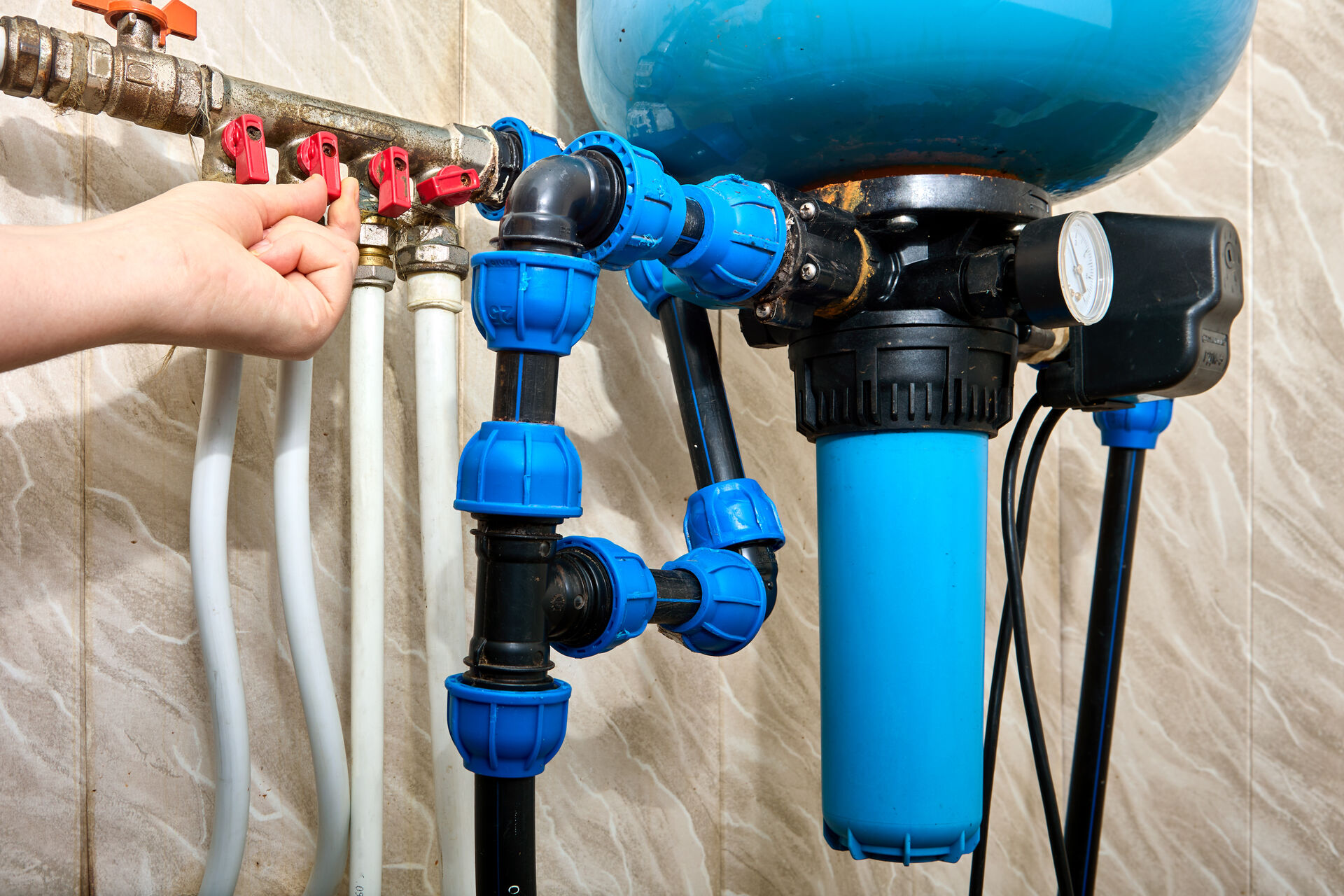
Sediment filtration is the foundation of any well water system and is installed first on the main supply line. A sediment pre-filter removes sand, silt, and fine particulates from well water before those particles reach any other treatment equipment or household plumbing. Filter sizing and media selection should match the particle load documented in a water test.
Ion exchange water softening is the standard solution for high mineral hardness. A softener exchanges calcium and magnesium ions for sodium ions, producing measurably soft water at every fixture throughout the home. System sizing should be based on your in-home hardness measurement and household daily water consumption, not a regional estimate. For wells at 15 grains per gallon or higher, a properly sized softener makes a significant difference in appliance protection, plumbing longevity, and daily water quality.
Iron and sulfur removal requires equipment designed specifically for the iron type and concentration in your water. Oxidizing filters using air injection or manganese greensand media convert dissolved ferrous iron to particulate form and then filter it out. Aeration-based systems address hydrogen sulfide by releasing the gas from the water before it enters the home. Because iron treatment equipment selection depends directly on the iron form and concentration in your well, a lab result covering iron speciation is necessary before any system is purchased.
UV disinfection is the chemical-free standard for bacteria treatment in well water. A UV light system installed on the main supply line after filtration destroys bacteria, viruses, and other microorganisms without adding any chemicals to the water. UV treatment must be installed after mechanical and iron filtration, because turbidity and dissolved iron significantly reduce UV penetration and effectiveness.
Reverse osmosis at the kitchen sink provides the highest level of purity for drinking and cooking water. An NSF/ANSI Standard 58-certified RO system removes nitrates, residual dissolved minerals, and trace contaminants to levels well below what point-of-entry systems achieve at the single drinking tap. NSF International maintains a certified product database at nsf.org. For households with nitrate concerns in well water, point-of-use RO is the most effective residential treatment.
Who is responsible for private well safety in Texas, and what does that mean for you?
Under Texas law, a private domestic well owner is solely responsible for the quality and safety of their water supply. No government agency tests, monitors, or enforces water quality standards for private wells serving a single household. This is a fundamental difference from municipal customers, who rely on SAWS, NBU, SSLGC, or another utility to meet Safe Drinking Water Act standards on their behalf through continuous monitoring, treatment, and regulatory reporting.
This regulatory structure places the full burden of testing, treatment, and maintenance on the property owner. A well that tested clean several years ago may show elevated bacteria or nitrates today due to changes in nearby land use, aquifer conditions, wellhead condition, or casing integrity. Testing is not a one-time action; it is an ongoing responsibility that TCEQ recommends meeting at least annually for bacteria and nitrates.
For well owners purchasing a home in the San Antonio area, requesting a comprehensive water quality test as part of the inspection process is strongly recommended. Most real estate transactions in the Hill Country and rural Bexar County that involve private wells include at least a bacteria and nitrate test, but a broader chemistry panel covering hardness, iron, TDS, pH, and manganese gives a far more complete picture of what treatment a new homeowner will need.
TCEQ does not have authority to require private well owners to test their water or remediate a contaminated well. The agency provides guidance and accredits the laboratories that perform testing, but enforcement over private domestic water supplies is not within its mandate. The responsibility is yours.
True H2O works with well water homeowners across Bexar County and the surrounding communities of Boerne, Helotes, Converse, Universal City, Schertz, Cibolo, and New Braunfels. Our water specialists understand the specific geology and water chemistry challenges of the San Antonio region. Call (210) 726-6895 to schedule a free in-home consultation and water quality assessment, or visit our water testing page to learn more.
Related Guides
- Well Water Treatment Options for Texas Homeowners
- US Well Water Quality Index 2026: State-by-State Rankings
- Does San Antonio Have Hard Water? 2026 SAWS Data
- How to Test Water Quality at Home in San Antonio
- Reverse Osmosis vs Whole-House Filtration
- Schedule a Free In-Home Water Test
- Water Treatment Services in Bexar County
Frequently Asked Questions
Does TCEQ regulate private well water quality in Texas?
No. Under Title 30 of the Texas Administrative Code, Chapter 290.3, private domestic wells serving fewer than 25 individuals are exempt from TCEQ public water system regulations. The well owner is solely responsible for testing, treatment, and maintenance. TCEQ provides guidance at tceq.texas.gov and maintains a directory of accredited testing labs, but the agency does not test, monitor, or enforce water quality standards for private domestic wells.
What are the most common contaminants in San Antonio area private wells?
The most common naturally occurring contaminants in limestone aquifer wells of the greater San Antonio area are mineral hardness (calcium and magnesium from limestone formations), dissolved iron, hydrogen sulfide, and bacteria. Nitrates are elevated near agricultural operations and septic systems. A TCEQ-accredited laboratory panel covering hardness, iron, coliform bacteria, and nitrates at minimum gives well owners a reliable picture of their specific water chemistry.
How often should I test my private well water in the San Antonio area?
TCEQ recommends testing a private domestic well for coliform bacteria and nitrates at least once per year, with a broader chemistry panel every three to five years. Testing should also follow any flooding event, nearby spill or chemical application, change in water taste or odor, or new ownership of the property. Test results must be obtained from a TCEQ-accredited laboratory to be valid for diagnostic and treatment decisions.
What is the Trinity Aquifer and who uses it in the San Antonio region?
The Trinity Aquifer is a multi-layered confined limestone and dolomite aquifer of Cretaceous age, covering much of south-central and north-central Texas, including Bandera, Medina, western Bexar, and Kendall County. Private wells in areas outside SAWS service frequently draw from Trinity formations. Like the Edwards Aquifer, Trinity water moves through limestone geology and commonly contains elevated hardness and iron. The Texas Water Development Board documents Trinity Aquifer characteristics at twdb.texas.gov.
Can a water softener solve all my private well water problems?
A water softener addresses hardness minerals (calcium and magnesium) only. If your well also contains elevated iron, hydrogen sulfide, bacteria, or nitrates, each requires a separate treatment system. A softener sized for hardness will not remove bacteria, nitrates, iron, or sulfur. A comprehensive water test from a TCEQ-accredited lab identifies which contaminants are present and at what levels, which determines which treatment systems are needed and in what installation order.
Concerned About Your Water Quality?
Schedule a free, no-obligation water test and find out exactly what is in your water.
Schedule Free Water Test